
NERD ALERT!
In every one of my Anatomy courses, there is always as least one mystery. A question will come up that I don’t know how to answer or I don’t do a great job answering. I, being me, can’t let it go and usually climb right down the rabbit hole to figure it out.
The question that came up last month in Anatomy in 3 Dimensions was:
What happens to the QL when someone has a rib removed?
It all came about innocently enough. When we were exploring the Quadratus Lumborum, I made a quip about how Victorian woman may have had a lot of back issues without their corsets, especially those who had their ribs removed. One of my students wondered if any of the 13 inch waisted famous waifs has any struggles with this.
No judgement here. If you have the means and the desire and it will make you happy, do whatever you will with your body, but I couldn’t help but wonder, what would happen if you completely removed a bone that a muscle was attached to?
In trying to get to the bottom of this I discovered two very important things. First, even I can be guilty of spreading misinformation, in spite of making it a mission to help others not do this. Two, the world of plastic surgery is weird to say the least.
I recall learning about Victorian Rib removal in Costume 101 in my undergrad, and I’ve heard it in a number of different circumstances. The claim is that Victorian women broke or had ribs removed in order to create waistlines as narrow as 13 inches. As I wandered down the research rabbit hole in 2025, I find that this is largely mythology with very little evidence to support it.
The horror! I’ve just done one of the very things that I loathe, especially in the Pilates space. I perpetuated unresearched rumor and myth. One of the reasons that I teach anatomy is to help eliminate the practice of blind regurgitation of half baked information. I apologize. Now, let me try and make it right by clearing up the mythology.
Given the conditions of medical science and surgery at the time, it is highly unlikely that a Victorian woman would have undertaken the brutal procedure of surgically removing a rib. Not only was the risk of infection and death much higher, there is nary a skeleton that has been found with evidence of removed ribs from this era. Maybe they broke the ribs instead? The research that I could find indicated that rib fracture was commonly found in Victorian skeletons, but not for the reasons we think. The fractures in ribs of this era were more likely from malnutrition (rickets) and poor living and working conditions within the working class, and less likely to be found in women of the upper class who would be wearing the more extreme corsets.
What is evidenced is ribs that were deformed over a life span of wearing these corsets. The natural curvature and angle that allows for the expansion of the ribs to assist in breathing morphs into something that is more fixed and almost horizontal, eliminating the pump handle motion in the lower ribs that assists with drawing in the breath by widening and elevating and and pressing the breath back out out by narrowing and lowering.
So, not a lot of lateral rib cage breathing with the Victorian era ribcages, right?
Fun fact: the reason why we don’t obsess over earlier corsets is because metal eyelets were not introduced until this era. This allowed for “tight lacing” because the metal eyelets could withstand more internal pressure without tearing the fabric. You could really pack a girl in. Earlier corsets without these metal reinforcements at the laces would tear at a certain point so you couldn’t pull them as tight. Tighter corsets equaled smaller waists as well as increased occurrences of fainting.
Now that we’ve debunked that mythology. Let’s get back to the question on the table. What would happen to the QL if a rib or two were removed?
For those not in the nerd know, the Quadratus Lumborum is a deep back muscle that connects the bottom rib, the lumbar spine via the spinous processes, and the pelvis bone. Our question was, if that rib goes away, what is happens to it?
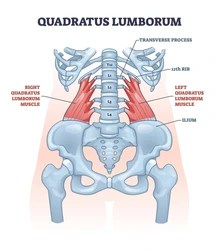
That night, I wandered around the internet and came up with nothing. Days later, I did what any wild and reckless person would do. I DM’ed a bunch of plastic surgeons on Instagram and regretted this decision within minutes. I got several responses offering free consultations to answer my question. No thank you. You can keep your black sharpie and payment plans far, far away from my body. It’s just not for me.
But one surgeon kindly and clearly responded. He said that if a rib were to be completely removed the QL would still be attached on the lumbar vertebrae, and it wouldn’t effect the function “too much”. He went on to explain that completely removing a rib was not common. Most likely, for those craving an aggressive tummy tuck, a surgeon would just do rib remodeling to change the shape. Thank you, Jonathan Dang, MD. You’re a prince among surgeons. (Check out his Insta. He’s kind of funny and easy on the eyes.)
Based on what I know, it seems like a fair assumption. Initially, when I started turning this over, I was thinking only about the single muscle. It is so easy to get lost in the granular consideration of individual muscles, but we can’t forget that no muscle works alone. Movement is created by a symphony of muscles and structures. So even if the rib were removed completely, the QL is still invested in layers of fascia, including the dense and multilayered thoracolumbar fascia, so it’s not like the muscle would just curl up into a little ball as if we just cut some rubber bands.
So there you have it. If a person did remove a rib, they more than likely would not completely fall apart.
Some of the stops in this rabbit hole:
 Lisa Moves